
The Capsule, the Covenant, and the Cure
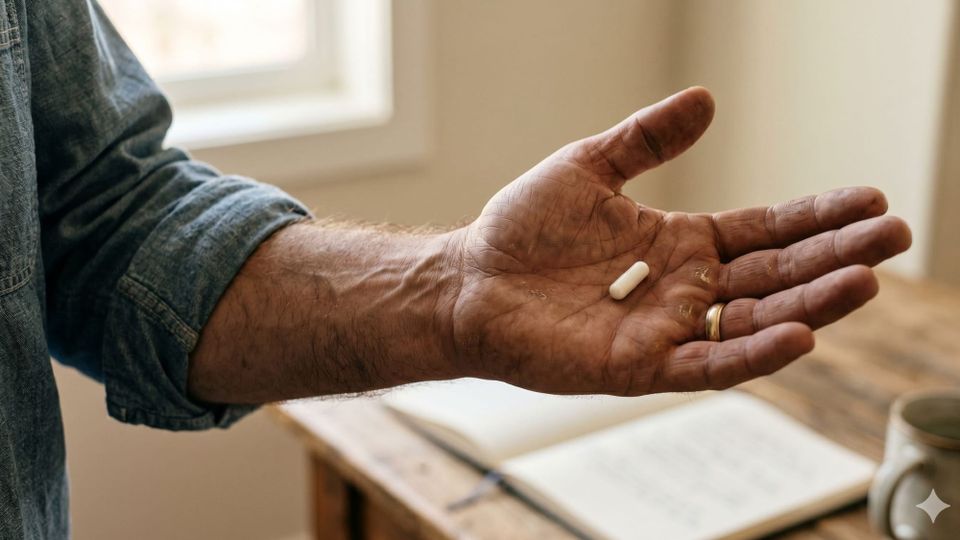
How the cure of Christ is delivered to a striving disciple — and what it asks of you in return.
Friend —
— · —
I want to invite you to something, and I want you to know what you are saying yes to before I extend the invitation.
So I will name the invitation now, in the second paragraph, where you can see it plainly:
Come and worship with me at the sacrament table. Come prepared — beginning Monday morning, not Sunday at eight. And if you have not yet bound yourself to the Lord by covenant, come and do that too. Come and be filled.
That is the invitation. The rest of this letter exists to show you what is inside it — so that when you say yes, you know exactly what you are receiving.
— · —
The Capsule
When President Russell M. Nelson taught the Saints about the sacrament, he reached for an analogy from his years as a heart surgeon.
He spoke of medication delivered in a capsule.
You hold a capsule in your hand. It is small. Plain. Easy to dismiss. The capsule itself is not the cure. It is the delivery mechanism of the cure. Inside the capsule is the medicine — the substance that, once received, begins to heal.
If you mistake the capsule for the cure, you will worship the shell.
If you refuse the capsule because it looks too plain, you will reject the medicine.
The capsule is unremarkable on purpose. It is designed to be swallowed without resistance, so that what is inside can do its work.
This is what an ordinance is.
— · —
Baptism is a capsule. So is confirmation. So is the temple endowment. So is the sealing.
So, week after week, is the sacrament.
Bread. Water. A few words spoken with exactness. Hands moving in a pattern set by revelation. People look at these things and ask, is that all? — yes. And inside is the cure.
The visible part is the capsule. The invisible part is the covenant. And the covenant is the channel through which the cure flows.
— · —
The Covenant
The word covenant has been worn smooth by frequent use. We say it almost casually. Covenant path. Covenant people. Keep your covenants. The word can begin to feel like a generic religious tag — interchangeable with commitment or promise or agreement.
It is not.
A covenant is a binding relationship. Two parties enter into it; both parties become bound; the binding does not break unless one party walks away. When you make a covenant with the Lord, you bind yourself to Him — and He binds Himself to you. Both halves are real. Both halves matter.
He says it directly: "I, the Lord, am bound when ye do what I say; but when ye do not what I say, ye have no promise." (D&C 82:10.)
Read that slowly. He is bound when you do what He says. The God of heaven and earth — who needs nothing from you, who can do His own work — has chosen to bind Himself to those who will bind themselves to Him, that He may give them all that He has. The relationship is not new. You knew Him before you came here. The covenant does not establish what already is — it wakes you to it, and opens the channel by which His love begins to flow to you in this estate. You are not negotiating. You are remembering. You are adoring. You are learning, by degrees, to honor Him with exactness — not imitating Him from a distance, but emulating Him as one who is being changed into His likeness, even as Jesus was one with the Father, so we are to be one with Him.
But the binding must be lived. You must do more than make a covenant. To merely proclaim it is to fall short of His glory. To become like Him is to live the fire of the covenant — not willing only to die for Him, but acting daily to live for Him — moving from innocence through the bitter, learning to cleave unto the good as the Man of Holiness did, seeking counsel from Him, even the Man of Counsel. (Moses 7:35.)
— · —
This is the medicine in the capsule.
The ordinance is the visible binding — the moment when, before God and witnesses, you stepped into a relationship that did not exist before. The covenant is the relationship itself, alive, carrying mutual obligation between you and the Lord every moment thereafter.
You can read the scriptures every day for fifty years and still feel the Lord at arm's length — because the relationship that brings Him close is not built through reading.
You can serve faithfully in every calling and still feel unmet — because the relationship that meets the soul is not built through service alone.
The relationship is built through covenant. And covenant requires the capsule.
The Lord could have flowed His healing through any means He chose. He chose the ordinance. He chose the covenant. He chose to bind Himself to those who would bind themselves to Him — and to make the binding a matter of visible, repeatable, embodied act.
This is not bureaucracy. This is design.
— · —
The Cure
In October of 1961, in a General Conference address called The Cause of All Our Troubles, Elder Spencer W. Kimball stood before the Saints and named the only cure for the sickness of the world.
He had cataloged the symptoms first — carelessness, casualness, covetousness, slothfulness, selfishness, dishonesty, disobedience, immorality, uncleanness, unfaithfulness, ungodliness. He had named the failed remedies the world keeps proposing. And then he said this:
That infallible cure [the panacea for life's ills] is simply righteousness, obedience, Godliness, honor, and integrity. There is no other cure.
Five plain words. No prescription pad. No specialist referral. Just the simple substance the soul has always needed.
And then Elder Kimball asked the question that would not let go of him — and should not let go of you either:
We can transform, but will we?
That question hangs over every page of this letter. The cure is real. The cure is simple. The cure has been named by every prophet from Adam forward. Will we receive it?
And here is the part that took me decades to see: the cure is simple — but it is not received simply. Righteousness, obedience, Godliness, honor, integrity are not items you check off a list by trying harder. They are the fruits of a soul being changed by a power outside itself. The natural man does not produce them, no matter how disciplined he becomes. They grow in a soul that has been bound to the Lord by covenant — and through that covenant has been receiving, week after week, the substance that fuels the becoming.
That substance has a name.
In Hebrew, it is hesed.
It is one of the great words of the Old Testament — translated loving-kindness, mercy, steadfast love, though no English word fully carries it. Hesed is the love that is bound. It is the love that flows specifically through covenant — and only through covenant.
It is not the general love God has for all His children. That love is real, and it is beautiful, and it falls on the just and the unjust like sun and rain. But that love is given freely without obligation on either side. Hesed is different. Hesed is the love that says: because you have bound yourself to Me, I will not let you go. I am yours. You are mine. I am bound.
The Psalms cry out for it on nearly every page. Remember Thy hesed, O Lord. Thy hesed endureth forever. Ruth pledges it to Naomi when she says whither thou goest, I will go. The whole architecture of Israel's relationship with Jehovah rests on it.
And in Doctrine and Covenants 82:10 — the very verse Elder Kimball reached for in that same 1961 sermon — the Lord says it in plain English: I am bound when ye do what I say. That is hesed spoken in the latter-day vocabulary.
This is the cure. This is what the covenant carries. This is what the capsule delivers.
— · —
When you receive the bread on Sunday morning — bread that is, materially, just bread — and you receive it in remembrance of Him, having prepared yourself for the meeting, having repented of the week's failures, having brought a hungering and thirsting heart — hesed flows.
At first you may feel it as a quiet steadying. In time it may swell within you like the mighty Missouri — a river of His covenantal love moving where before there was only dry ground.
It is the delivery mechanism of the atonement. The capsule is in your mouth. The cure is going to work.
This is why the sacrament is weekly. Not because we forget weekly, though we do. Not because we sin weekly, though we do. The sacrament is weekly because the cure is best taken weekly. You renew the covenant; hesed flows again. You receive the capsule; the medicine begins again. The Lord designed the rhythm.
— · —
The Manifestation
Here is what most letters about the sacrament leave out.
The covenant is not a destination. It is a doorway.
The covenant gets you inside the room where hesed flows — and once hesed is flowing, something begins to happen to you. You begin to be filled. This is the word the Savior used when He stood on the mount and said blessed are they who do hunger and thirst after righteousness, for they shall be filled with the Holy Ghost. (3 Nephi 12:6.)
It is the word the Lord used in Kirtland when He said if your eye be single to my glory, your whole bodies shall be filled with light, and there shall be no darkness in you. (D&C 88:67.)
Filled.
The capsule is swallowed. The covenant is renewed. Hesed flows. And you — small, ordinary, struggling you — begin to be filled. With light. With the Holy Ghost. With the constant companion who teaches and shows and tells.
Nephi laid out the path with precision: the words of Christ will tell you all things what ye should do; the Holy Ghost will show unto you all things what ye should do. (2 Nephi 32:3, 5.) Both modalities. Tell and show. Christ's words narrate; the Holy Ghost illuminates.
And then verse 6 makes the staggering claim: obedience to His words, under the tutorship of the Holy Ghost, is preparation. Preparation for what?
The manifestation of Christ.
Not a metaphor. Not an inner feeling. The manifestation of Christ in the flesh, Nephi says. The Second Comforter. The encounter the Brother of Jared had on the mountain. The encounter Joseph Smith had in the grove and in the temple. The encounter promised to every faithful disciple who hungers and thirsts after righteousness and continues until they open the door at which Jesus stands knocking.
Three stages, by my reading of the prophets:
First, He becomes vivid in your mind's eye — through feasting on His words, through the daily milking of scripture, through living under the Spirit's narrating and illuminating tutorship.
Second, He becomes real in the eye of faith — as you become pure even as He is pure, perfected by degrees in the nature of His character, perfections, and attributes, until you begin to see Him in the mirror.
Third, He comes in reality — Brother-of-Jared territory — and abides in your presence from time to time, because by then you have been changed enough to bear His company. The exercising of your faith brought you here. The becoming makes the abiding possible. And the covenant carried the hesed that fueled the becoming — fuel to be one with Him, as He is one with the Father, even the power of godliness.
— · —
This is what the capsule contains. This is what the covenant carries. This is what the cure is for.
Not just relief. Not just forgiveness. Not just comfort.
Direct encounter with the living Christ.
The sacrament every Sunday is a small step on that road. Each week the capsule. Each week the covenant renewed. Each week hesed flows. Each week you are filled a little more, changed a little more, prepared a little more for the meeting that awaits the faithful.
This is what is at stake when the deacons pass the tray.
— · —
The Preparation
If this is true — and I witness that it is — then the preparation matters.
You cannot prepare for the sacrament on Sunday morning. The bread is being broken before you have finished combing your hair. By the time you reach for it, the preparation should already be done.
Monday morning, before the day begins, you sit down with the cow.
You bring the question — Lord, what is the invitation You want me to receive this week, and what will You teach me before Sunday? You milk what the scriptures and the best books give you. You let the cream rise. You write down what you receive. You walk through the week carrying the question, listening for the answer, repenting as the Spirit identifies what needs repenting. As you turn to Him in heart and mind, the Spirit fills you with further light — even pure intelligence — and you grow, by degrees, into the principle of revelation, until you become perfect in Christ Jesus.
By Saturday night you have spent six days walking with the question.
By Sunday morning the capsule is held out, and your soul is hungry, and your heart is prepared, and the covenant is ready to be renewed.
That is when hesed floods. That is when the filling happens. That is when the manifestation arc takes another step forward.
The unprepared receive the capsule and miss the cure. Not because the Lord withholds it — but because the soul has not yet emptied itself enough to be filled.
— · —
The Invitation, Reissued
So I return to the invitation I named in the second paragraph.
Come and worship with me at the sacrament table.
If you have not yet entered into the covenant by baptism, come and do so. The capsule is held out to you. Hesed is waiting on the other side of the binding.
If you have entered into the covenant but have grown casual at the table, come back with sobriety. Begin Monday. Sit down with the cow. Carry the question through the week. Arrive Sunday hungry, single-eyed, ready to be filled.
If you are walking the path well already, walk it deeper. The manifestation arc has further stages. The mind's eye opens to the eye of faith. The eye of faith opens to the meeting in reality. He comes, and abides from time to time — but only for those who keep coming, keep milking, keep receiving the capsule, keep letting the cure do its slow holy work.
I witness that the cure is real. I witness that hesed flows where the covenant binds. I witness that the manifestation of Christ is the destination toward which all of this points — and that He is more eager to meet His faithful than His faithful are eager to be met.
The sacrament tray will be passed in your meetinghouse this Sunday.
Be ready.
— · —
Come — do greater works than these.
— Kent
— · —
A Closing Verse
The capsule is plain. The cure is hid. The covenant binds what the bread foretold. Hesed flows where the soul is bid To hunger, to thirst, and to be filled with gold — Not the gold of kings, but the gold of His face, The slow unveiling, the long-meant grace. Come Monday morning. Sit down. Begin. The cow is patient. The cure flows in.
— · —
A Note of Gratitude
The capsule analogy I owe to President Russell M. Nelson, the heart surgeon, who saw in his work the careful design by which a healing substance is delivered to where it must go. I received it through Elder Steven V. Shumway of the Seventy at a stake leadership session in our valley, where the sacrament was called the delivery mechanism of the atonement. That phrase has not left me. The diagnosis and the panacea I owe to Elder Spencer W. Kimball, who in October 1961 named the world's sickness and the only infallible cure with prophetic clarity that has not aged a day. The covenant frame, the hesed exposition, and the Man of Counsel anchor are what grew from those seeds in the morning hours after. I am grateful for every laborer whose work has shaped mine.
Read alongside this letter:
— The Napkin Equation — the math of grace, and the yoke that activates it — The Alchemy of the Yoke — what the yoke does to the one who wears it — Called to Greater Works — the minister, the mission, and the mathematics of infinity
These four letters are written to be read together.